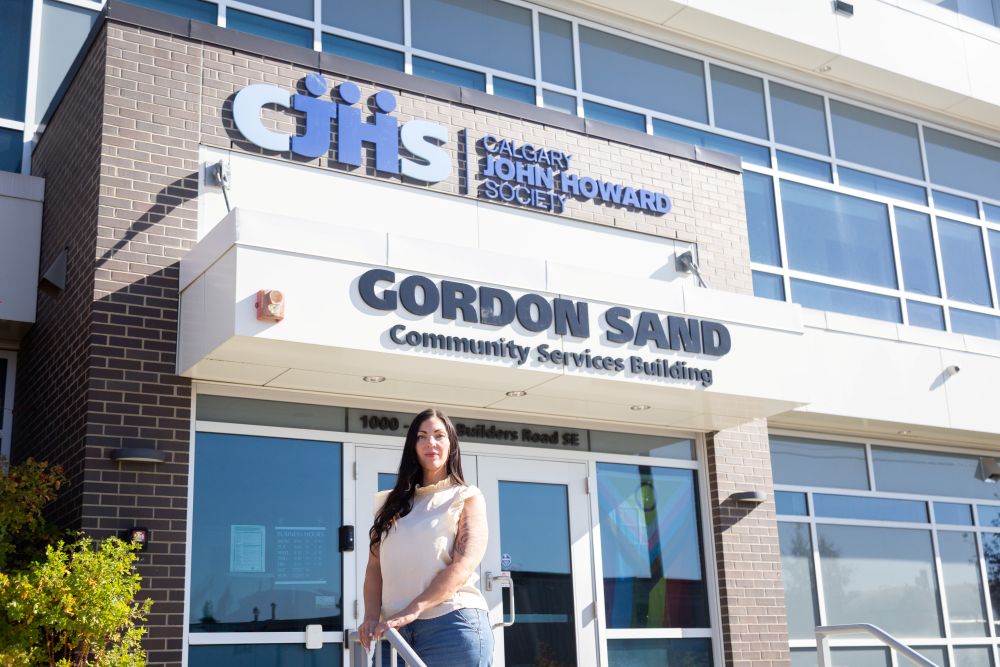
Natalie Noble became Executive Director of the Calgary John Howard Society in January 2025, stepping into a role that felt like a natural extension of a career spent believing in second chances. A social worker by training who spent years at the Drop-In Centre before joining CJHS, Natalie came up through a sector that gets under your skin, one where you see firsthand what becomes possible when someone gets the right support at the right time.
Describe your charity/non-profit/volunteer work in a few sentences.
The Calgary John Howard Society has been making Calgary safer by reducing crime for over 75 years. We work with people who are involved in the justice system to help them get what they need to move forward, whether that’s a place to live, a job, education, or people around them. When people have the opportunity to build stable lives, they are less likely to return to crime, making communities safer for everyone.
What problem does it aim to solve?
Safer communities start with addressing the root causes of crime, like trauma, poverty, and lack of opportunity. Crime doesn’t happen in a vacuum. When people exit jail with nowhere to go, no job, and no support, they often end up back in the same situations that got them there in the first place. We work to break that cycle.
When did you start/join it?
I started in January 2025.
What made you want to get involved?
Honestly, I’ve always believed in second chances. I came up as a social worker and spent years at the Drop-In Centre before joining CJHS. This sector gets under your skin. You see what’s possible when someone gets the right support at the right time, and you can’t unsee it. That’s why I’m here.
What was the situation like when you started?
Within months of joining, we faced one of the biggest blows in our recent history. We lost $835,000 of funding for our adult housing program in May 2025. This was the only program of its kind in Calgary with 40 housing spaces designed specifically for people leaving incarceration and at risk of homelessness, with wraparound supports for addiction, mental health, and employment. It wasn’t cut because it wasn’t working. It was cut because of funding pressures across the sector. The outcomes spoke for themselves: 88% of participants remained housed, 81% of those with a criminal history reduced their criminal activity, and participants were nearly twice as likely to access addiction services compared to those without housing. Losing that program showed me exactly what we’re up against and why this work matters so much.
How has it changed since?
We’ve become a more vocal advocate for systems change. There’s growing recognition that public safety and supporting people in the justice system aren’t competing goals. They’re the same goal.
Losing AHRP was a painful reminder that progress is fragile and that the housing gap for people leaving incarceration is still very real. It also confirmed what our team knows: stable housing isn’t a luxury add-on to recovery and reintegration. It’s the foundation everything else is built on. We’re committed to restoring that capacity and making the case for sustainable investment in housing as a public safety strategy.
What more needs to be done?
Housing must be a priority. Right now, people are being released from custody with nowhere to go. They end up in emergency shelters or on the street, and the research is clear that without stable housing, recovery and reintegration are nearly impossible. We need governments and communities to invest in transitional housing for people exiting the justice system, not as charity, but as a smart public safety strategy.
We also need to reduce the barriers people face when they’re trying to rebuild. Things like no home, no income, no education, no job, no job prospects, no ID and limited supports. These aren’t small problems. They push people back toward crime when they’re trying their hardest to move forward.
How can our readers help?
One of the most powerful things people can do is shift how they think and talk about crime and justice. The people we work with are parents, siblings, and neighbours. Most of them want to turn their lives around, and they’re more likely to succeed when communities give them a real shot.
If you’re able to give, donations to CJHS go directly toward housing, employment programs, and wraparound supports that make our community safer. And if you’re an employer, consider hiring someone with a criminal record. We can connect you with motivated candidates and support the transition.
Do you have any events coming up?
Yes! We’re planning a community celebration for October. It’s been a big year for us — we have a new strategic plan launching that focuses on crime prevention and public safety, and we want to mark that with the people who make this work possible. Details are still coming together, so keep an eye on our website at cjhs.ca for updates.
Where can we follow you?
Website | Facebook | Instagram | LinkedIn
PAY IT FORWARD: What is an awesome local charity that you love?
I really admire the Islamic Restoration Society. They work with people from all backgrounds who are involved in the justice system, while bringing real expertise in supporting Muslim individuals through services rooted in faith, culture, and community. Their belief is that staying connected to those things is part of what helps people heal and rebuild their lives.
They’re also outspoken advocates for a justice system that treats everyone with dignity. Racialized communities are overrepresented in the justice system, and IRES makes sure those experiences are understood and that people get support that reflects their background and identity. That kind of work is so needed, and it lines up closely with both my personal values and the values of Calgary John Howard Society, which are grounded in compassion, inclusion, and the belief that everyone deserves the opportunity to grow and successfully reintegrate into the community.